Seem to have been quiet for a while, though have been doing a little on Twitter (@Volandia), Facebook and LinkedIn. Main reason has been that late last week, just as I was about to start a long-planned break this week, with Sam also away in Rio, a request came in from WWF International for a quick survey of where the NGO world seems to be headed. Quite a challenge, but have been consulting with a range of people around the world and getting some wonderful personal assessments of where things are–and where they may be headed. Should have an advanced draft ready late today to send to WWF this evening, with the final version due late Friday. More anon, I’m sure.
Journal
In the President’s Hands
President Piñera has the Power
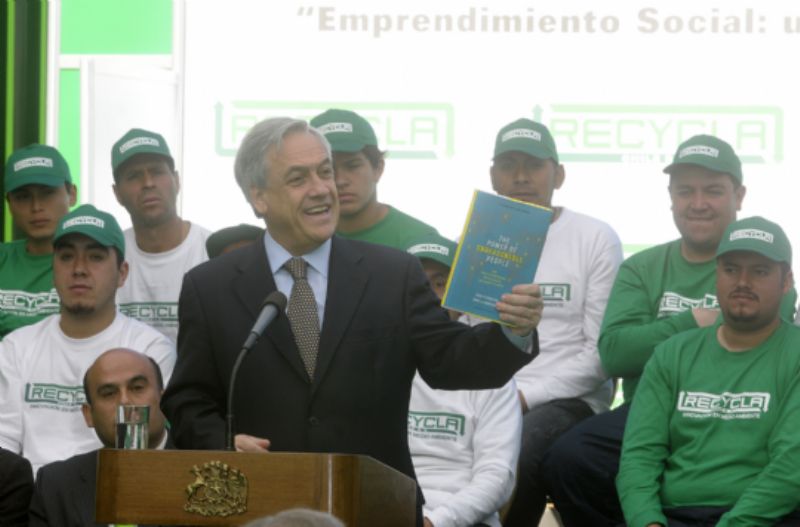
Nice to see Chilean President Sebastián Piñera brandishing our book The Power of Unreasonable People, though he has a complicated history, it seems. This was an event organised by our favourite Chilean social enterprise, Recycla, who feature in the book.
Drought, Fire and Flood
Often, the future asks the past why it couldn’t see what was in front of its nose? After a rather frantic time week, I have been working at home today, focusing on a challenge we face in Singapore and on the follow-up to our Biosphere Economy project. In the process, it kept being borne in on me that apparently disconnected events in today’s world would look very different through tomorrow’s lenses.
Take the devastating drought and fires currently impacting Russia. Many people will think that this is something solely for the Russians, while others may feel that there is a measure of poetic justice for a country that has been pretty recalcitrant on climate change – believing that it will be advantaged as the warming trend opens up northern areas to farming and minerals extraction.
But the evidence is that what is happening in Russia is going to have a pretty immediate impact on the lives of millions of people living elsewhere, not least through food prices. As the Financial Times reports today on its front page, wheat prices have risen faster than at any time since 1973 as the implications of the lost grain production in Russia are factored into markets.
And then there is what is happening in Pakistan, with devastating floods – all of which may look disconnected from what is happening in Russia and from what will happen in the future. The BBC reports that 2.5 million people have already been affected in Pakistan. While all of this may seem a long way off for those of us on the other side of the world, the implications for our security and for future would look a great deal clearer from the perspective of someone looking back from, say, 2030.
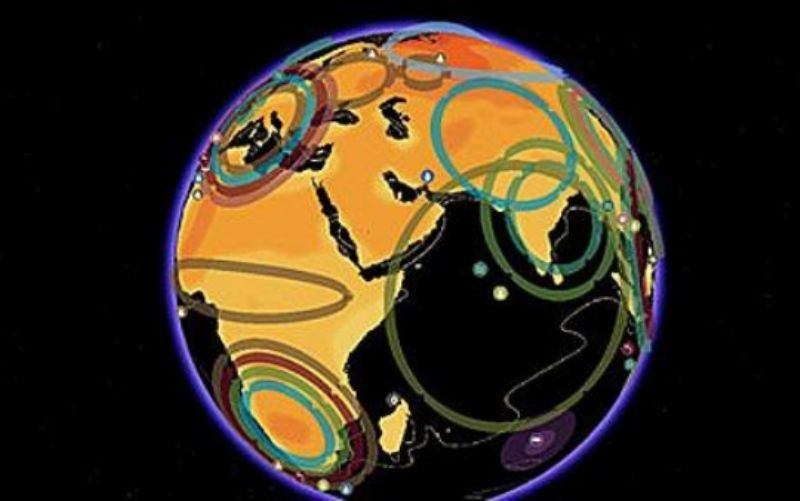
I don’t know whether the sort of mapping that Google Earth is now offering – or the mapping developed by agencies like the UK Met Office – will help people see what is increasingly before their eyes, but somehow I doubt it. Too much else is before our eyes in the same moment – and the sorts of trajectories our climate may now be on are totally outside our experience.
Someone asked me yesterday whether I was an optimist – and, truth be told, I am, but in the context of the sort of analysis offered by Jared Diamond in his book Collapse. Whereas Adolf Hitler thought that the Third Reich would last 1,000 years, and the architects of the British Empire probably dreamed of something for similar for the pink-painted areas of the globe, my sense is that we will get increasingly used to seeing images of the globe with swelling yellow, orange and red zones showing the areas where global warming – or heating, as some suggest it should not be called – is steadily bringing our planet to the boil.
I shared a platform earlier late last week with Lord Giddens, at an event held in the National Liberal Club, and his odyssey into climate science in recent years (as an open-minded non-scientist) made me wish every business and political leader could spend a day with him. There were still one or two climate skeptics in the room, which made me wonder whether in a decade or two such people will have converted or gone underground, for fear of meeting with rough justice? One question that has been in my mind for some time is whether there could be some form of retrospective justice, perhaps an Ecological Crimes Tribunal, with the criminalisation – even demonisation – of today’s climate-deniers?
New Look for SustainAbility.com
The new SustainAbility website can be found here – I think it’s a big improvement.
Visualizing the Word Sustainability
Two years ago, Stora Enso, the Scandinavian paper company, commissioned six designers to create posters inspired by the word Sustainability. The winning designs came from Marian Bantjes, Bruce McCall, Christoph Niemann, Michael C. Place, Paula Scher and Winterhouse. Sadly, the series was cancelled when the paper company sold its U.S. operations after printing and distributing only the Bantjes, Niemann and Scher works. But all six are now downloadable for free from a website which I found via a Big Think link Will Rosenzweig of Physic Ventures sent me today.