• Skip to primary navigation
  • Skip to main content
  • Skip to primary sidebar
John Elkington

John Elkington

A world authority on corporate responsibility and sustainable development.

  • About
    • Ambassador from the future
  • Past lives
    • Professional
      • Volans
      • SustainAbility
      • CounterCurrent
      • Boards & Advisory Boards
      • Awards & Listings
    • Personal
      • Family
      • Other Influences
      • Education
      • Photography
      • Music
      • Cycling
    • Website
  • Speaking
    • Media
    • Exhibitions
  • Publications
    • Books
    • Reports
    • Articles & Blogs
    • Contributions
    • Tweets
    • Unpublished Writing
  • Journal
  • Contact
  • Show Search
Hide Search
You are here: Home / Journal

Journal

Happy Birthday, Land Rover

John Elkington · 12 October 2008 · Leave a Comment

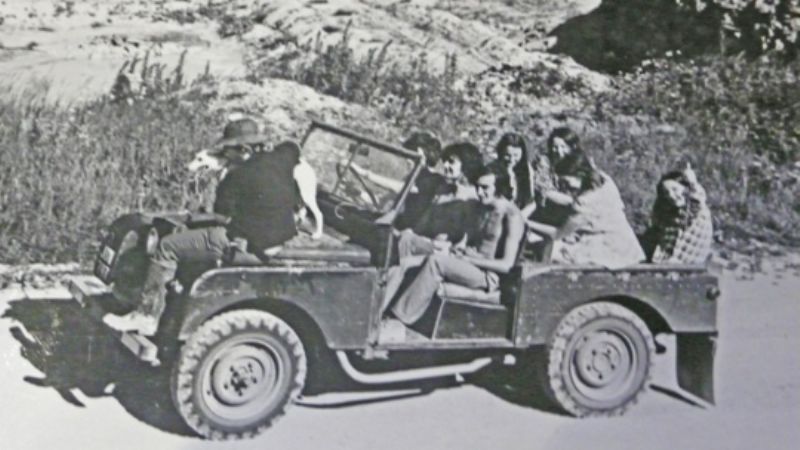
Our Land Rover with Blue, the whippet, as bonnet mascot Our Land Rover with Blue, the whippet, as bonnet mascot

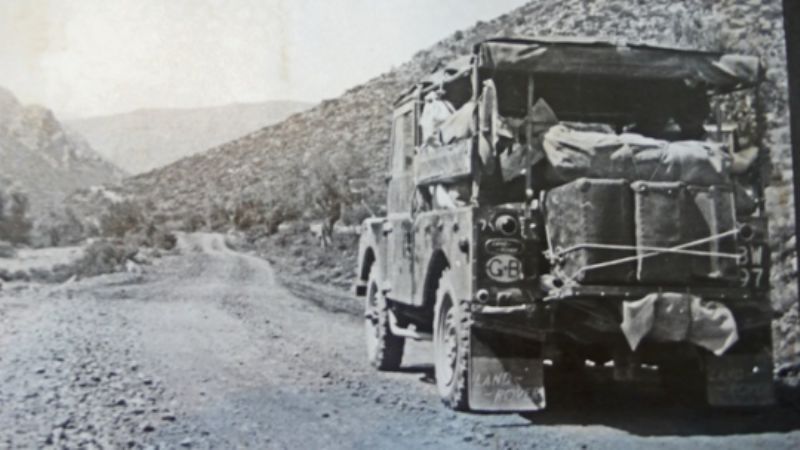
It’s sixty years since the first Land Rover took to the road, in 1948 – the year before I was born.  Its registration number was HUE 166.  For close on 20 years in the 60s and 70s, my family had a vehicle which didn’t look much different, JBW 797.  It was old even when we got it, the story being that it had been twice around the world already and at one stage had served as a logging vehicle.

Whatever its family tree and previous exploits, it became a centre plank of our younger years, a porch on wheels, a rough-and-tumble covered wagon.  We would put it in the lowest gear as we drove across Little Rissington airfield, leaving it to its own devices as we all dived off to find and pick mushrooms.   We treated it to excursions in a nearby quarry, in the days when we still shot things – and I recall one time, with the canvas top removed, when we drove back through Bourton-on-the-Water in the rain, with at least one of our party wearing a huge snorkel mask and another plucking something, with the feathers strewing out in our wake.

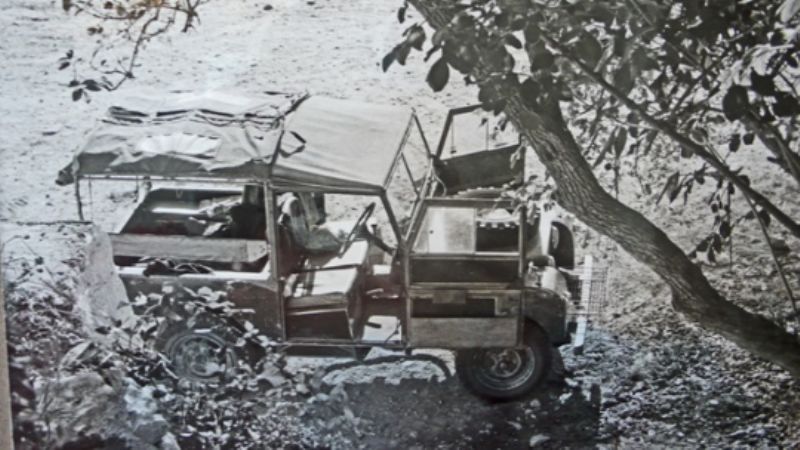
In 1970, Elaine and I took it – and four friends from university, ian, Jan, Martin and Rex – to Greece for two months, taking the ferry to Skiathos and then on around the Pelopennes.  During that trip, it turns out, we bumped into Geoff Lye, much later a colleague at SustainAbility and Volans, who was driving around the Greece with friends in a London black cab. 

It was a wrench when the family finally sold JBW 797, but by then its alumium body was corroding fairly badly – and its paintwork had worn down to silver on the wings and bonnet, where we seemed to spend much of our time – as shown in the photo above.

So happy birthday to HUE 166, to whatever is left of JBW 797 and to Land Rover. That said, I do wonder whether a decade hence we will look back and see that Land Rover – like many other automakers – took a dangerous detour in plunging so wholeheartedly into the SUV era.  True, as Land Rover insists, the vehicle has served brilliantly in an endless number of scientific and environmental projects, but the marque has become much more closely identified in recent years with the 4×4 plague of Chelsea Tractors.  If conspicuous consumption becomes less socially acceptable, it will be fascinating to watch the Land Rover mutate back closer towards its original functions.

JBW 797 in Greece JBW 797 in Greece   JBW 797 in the Pelopennes JBW 797 in the Pelopennes

In the eye of the storm

John Elkington · 11 October 2008 · Leave a Comment

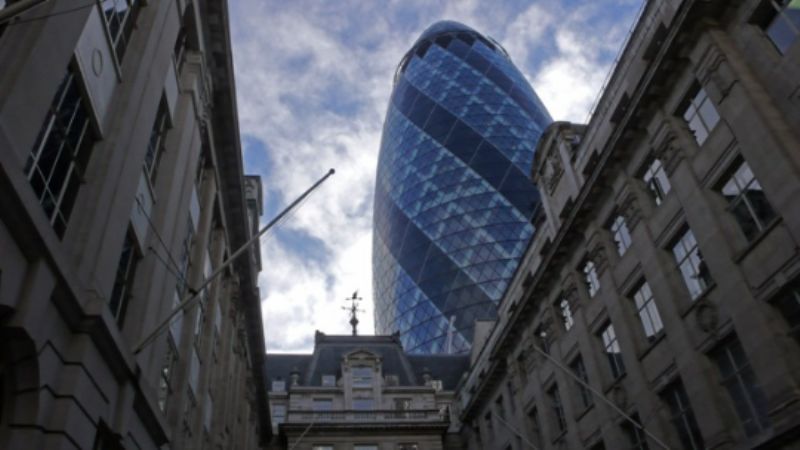
En route to the London Accord En route to the London Accord

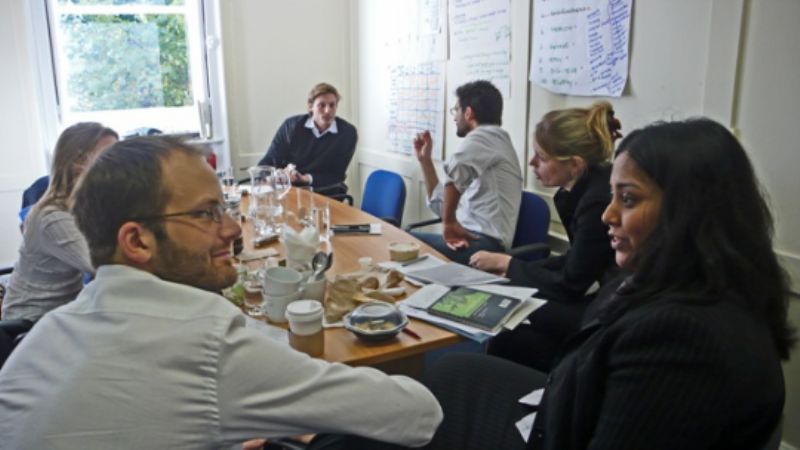
With the financial world tumbling around our ears, Charmian and I went early in the week to find out more about the London Accord from Michael Mainelli of the Z/Yen Group.  A fascinating initiative which aims to blend social, environmental and financial agendas and that deserves to be even more widely known.  A little later in the week, Doug Miller of the European Venture Philathropy Association kindly came in and did a 101 session for a group from Volans and SustainAbility.  Spent a fair amount of the week doing client work, writing articles and preparing presentations, all of which are tending to refer back to the work of Nikolai Kondratiev and Joseph Schumpeter, two economists whose work had a profound influence on the way I see the world.

London’s future as a financial centre is being questioned by some as the market turmoil continues, but the current crisis and suffering is put in perspective by something Elaine told me today.  I have always wondered why the Piccadilly Line jinks about and makes such a screeching noise between South Kensington and Knightsbridge stations.  The reason, according to Catherine Arnold’s book Necropolis, is that the line had to be routed around huge numbers of corpses that had been buried near Rotten Row during the Great Plague.  Something else to think about as I cycle nearby on my way to and from work.

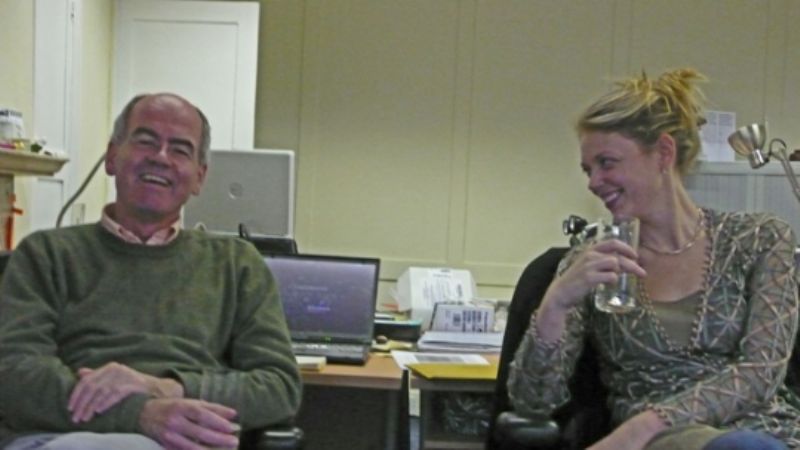
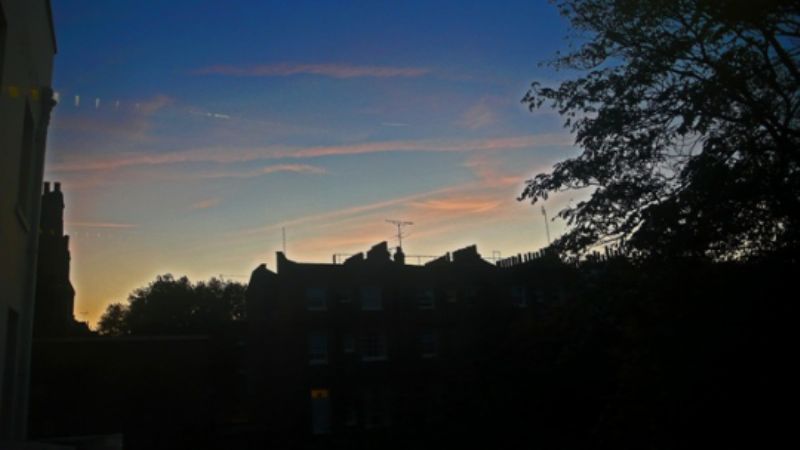
The conversation continues after Doug Miller has gone The conversation continues after Doug Miller has gone   Charmian and I ... Charmian and I …   ... are among those celebrating Smita's joining full-time … are among those celebrating Smita’s joining full-time   Sam reclines Sam reclines towards the end of another frenetic day   Am I turning into a silver-back gorilla? With Sam, Astrid and Smita: am I turning into a silver-back gorilla?   The sun sets over London at the end of another day of financial carnage Deceptive: the sun sets over London – after another day of financial carnage

Black or White, can the next President Green the White House?

John Elkington · 11 October 2008 · Leave a Comment

As I pushed my cycle through the front door last night after arriving back late from Volans, Elaine asked me whether I wanted to watch Simon Schama on BBC – the first programme in a new series on the American Future. We proceeded to do so and it proved to be the most extraordinarily powerful indictment of a particular style of development that has pushed much of the US economy ever-closer to water scarcity, just as pioneers like John Wesley Powell warned that it would.

The spooky thought I was left with after watching the programme – and on the back of work I have been in recent days, going back to my interest in the late 1960s in the waves theories of economists Nikolai Kondratiev and Joseph Schumpeter – was that maybe we stand on the threshold of a depressive era, as Kondratiev’s theory would suggest, with climate change-related issues representing the next decade’s version of the American Dustbowl tragedy.

In an email a week or so ago, Bill Drayton of Ashoka noted that the Great Depression spawned many of the social and financial institutions that we now take for granted. This uncomfortable thought, that we need such meltdowns to drive what Schumpeter called “creative destruction” and, in the process, create the pre-conditions for the next great cycle of innovation, economic development and institution building was central to my 2001 book, The Chrysalis Economy (Wiley/Capstone, 2001). The notion here was that the first 30 years of the twenty-first century would face profound discontinuities as our old ‘caterpillar’ economy began to metamorphose into something more like a ‘butterfly’ economy. I warned, however, that times of stress could turn large slices of our world into ‘maggot’ economies.

The social and ecological dislocations of such discontinuities will be profound, and not simply because of all the private equity and hedgefund people who will lose their jobs. How is Iceland, for example, going to pay back even a proportion of its national debt – by decimating cod stocks? Let’s hope not, but there are likely to be Strange Days indeed. History suggests that in periods of turbulence, new movements can erupt and gain momentum at astonishing speed, including those driven by extremist politicians. As a countervailing force, we need to shift our various sustainability-related movements onto something more like a ‘war’ footing. We need to be both more political and more programmatic.

On the (strongly) plus side, one of the people I have long hugely respected is Green for All founder Van Jones, the powerhouse behind the Green Jobs Now movement in the US. “We can’t drill and burn our way out of the current crisis,” is the motto of the Green Jobs people. ”But, working together, we can invest and invent our way out.”

Some background from their website: “Green For All is a national organization dedicated to building an inclusive green economy strong enough to lift people out of poverty. By advocating for local, state and federal commitments to job creation, job training, and entrepreneurial opportunities in the emerging green economy – especially for people from disadvantaged communities – Green For All fights both poverty and pollution at the same time. Green For All is working with other organizations to advocate for the formation of a Clean Energy Corps (CEC). The CEC would serve as a combined service, training, and job creation effort to combat global warming, grow local and regional economies and demonstrate the equity and employment promise of the clean energy economy.”

As it becomes ever clearer that the next President of the United States will inherit a poisoned chalice, so the need to link bail-outs to investment in the real economy of the future will intensify – and Jones and his colleagues seem key to that potential world order, alongside people like Amory Lovins of the Rocky Mountain Institute, where the mantra is ‘Abundance by Design.’ Watching the Presidential debates and reading the analysis of the rival candidates, McCain – for me at least – emerges not as ‘McSame’, though there will inevitably be elements of that, but as a man whose thinking and choices are too quirky for what we now face. Obama may or may not have the makings of an FDR-like President, but the tsunami of news sweeping in all around reminds me of something that Churchill once said, to the effect that extraordinary times call forth extraordinary people – and extraordinary leaders.

It needs an FDR-like leader to jump the current green movements to the point where Green Collar work is aspirational for millions and then billions of people. Whoever is the next man in the White (or Green?) House, he will need to build and communicate a vision not only of ‘Hope’ but of very practical steps and stepping stones that will carry us into the next Kondratiev Wave in good order. My vote is would be for a President willing and able to tap the Power of Unreasonable People at an unprecedented scale and speed. Meanwhile, I suspect, we are going to see something of shake-out in the various movements pushing for such changes, including, I fear, those represented in the Volans Trailblazers portfolio. My hope here is, to paraphrase the late Anita Roddick, that what doesn’t kill us will make us stronger …

Now I’m in this Big Black Book

John Elkington · 6 October 2008 · Leave a Comment

Went along to an event at The Wallace Collection, Manchester Square, this evening, not knowing what to expect.  Found myself featured in a 116-page ‘Big Black Book’ – the Evening Standard‘s version of ‘London’s 1000 Most Influential People‘.  Among the people I caught up with was Koy Thomson, now CEO of the London Cycling Campaign, whose full-page photo (cycling across Tower Bridge with a phalanx of other cyclists) graces the page opposite my entry.  Love what they do.  Merited or not, it’s great to be in such distinguished company, though something of a shock to see my age listed as 59. Again, some part of the brain protests, some mistake surely?  

Still, much better than the ‘Blue Book’ that the wretched John Birch Society used in the heyday of the McCarthyism to pillory those suspected of Communism or unduly left-wing sympathies.  Read their Wikipedia entry and they seem almost benign, but during the Vietnam War they were vicious.  I remember visiting one man who had ended up in the Blue Book when Elaine and I were on our ‘honeymoon’ in the Pacific Northwest, having finally decided to get married after five years together to ensure cheap flights to the US.  This was Professor Giovanni Costigan, a lovely man who made us completely at home.  One of the people I wish I could have bottled, in the positive sense.

Ghost bikes

John Elkington · 5 October 2008 · Leave a Comment

In St. Louis, Patrick Van Der Tuin began memorializing bicyclists killed or injured by motorists with painted white bikes in 2002. He called his project Broken Bikes Broken Lives. (Courtesy of Carrie Zukoski) In St. Louis, during 2002, Patrick Van Der Tuin began memorializing bicyclists killed or injured by motorists with white-painted bikes. He dubbed his project ‘Broken Bikes Broken Lives’. (Photograph courtesy of Carrie Zukoski)

Haven’t yet seen one in the flesh, but am mightily impressed by a very different take on white bicycles, the viral campaign splashed over two pages in today’s Observer.  Starting off in the US, it uses skeletally white-painted cycles to mark the spots where cyclists have been killed or injured.  Given that a young woman cyclist was killed by a bendy bus just around the corner from our London office a week or two ago, and having been left three times unconscious over 35 years of cycling in London, twice with three broken ribs, the ghost bike movement is one I whole-heartedly support. 

  • « Go to Previous Page
  • Go to page 1
  • Interim pages omitted …
  • Go to page 254
  • Go to page 255
  • Go to page 256
  • Go to page 257
  • Go to page 258
  • Interim pages omitted …
  • Go to page 283
  • Go to Next Page »

Primary Sidebar

Introduction

I began this blog with an entry reporting on a visit to the Woods Hole Oceanographic Institution on Cape Cod, on 30 September 2003. The blog element of the website has gone through several iterations since, with much of the older material still available.

Like so many things in my life, blog entries blur the boundaries between the personal and the professional. As explained on this site’s Home Page, the website and the blog are part platform for ongoing projects, part autobiography, and part accountability mechanism.

In addition, my blogs have appeared on many sites such as: Chinadialogue, CSRWire, Fast Company, GreenBiz, Guardian Sustainable Business, and the Harvard Business Review.

Recent Comments

  • John Elkington on The Hill House Elkingtons
  • sally fitzharris. (Rycroft) on The Hill House Elkingtons
  • Thomas Forster on Reminder of Glencot Years

Journal Archive

About

John Elkington is a world authority on corporate responsibility and sustainable development. He is currently Founding Partner and Executive Chairman of Volans, a future-focused business working at the intersection of the sustainability, entrepreneurship and innovation movements.

Contact

john@johnelkington.com  |  +44 203 701 7550 | Twitter: @volansjohn

John Elkington

Copyright © 2026 John Elkington. All rights reserved. Log in